
Keeping track: what happens after a Prosper cohort?
Published:04/09/2026 by Stefania Silvestri Reading time:10 minutes

One of the questions we're asked most often about Prosper is also one of the most difficult to answer: What happens next?
We know what participants tell us at the end of the programme. We know how they feel about the workshops, resources and opportunities to connect. But careers do not develop over a few weeks or months. They unfold over years, often in ways that are difficult to predict.
That is why we've continued to keep in touch with the two Prosper pilot cohorts long after they completed the programme. Alongside longitudinal surveys issued annually, we've also used publicly available information to understand where people's careers have taken them and how their professional journeys continue to develop.
As we've looked across the data, five themes have stood out. [You can download the full report]
1. There is no single career path
If there is one thing we've learned from tracking participants over time, it's that there is no typical destination.
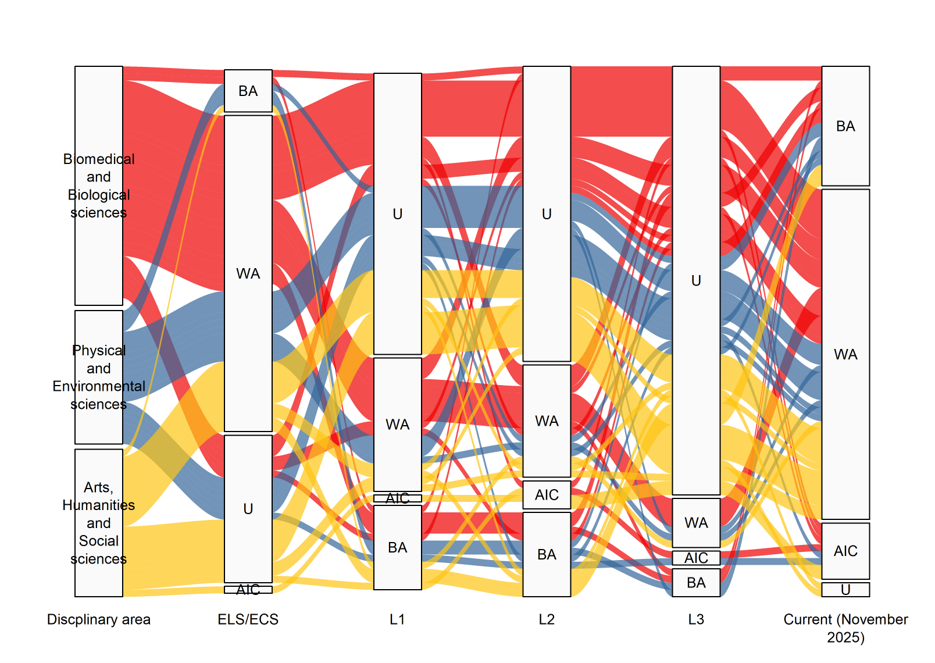
Some participants have remained in academia, progressing into research, teaching and leadership roles. Others have moved into careers beyond universities, applying their skills in sectors ranging from business and industry to the public and third sectors. Some have built careers that sit somewhere in between, spanning academia and external organisations.
Prosper gave me the confidence and tools to look for jobs beyond academia. For example, my current role was possible because I was able to network through LinkedIn, something I never took seriously before Prosper.
Pilot cohort 2 member
Looking across both pilot cohorts, the majority of participants are currently working within academia, but a substantial proportion have moved beyond it, while others occupy hybrid roles connecting academic and non-academic environments.
I left academia, but returned months later. It took some time but I've finally been awarded a Fellowship so I'm excited to embark on it now.
Pilot cohort 1 member
What's perhaps most interesting is that the journeys themselves are often more varied than the destinations. Career moves rarely happen in a straight line. People explore options, test different roles and respond to opportunities as they arise. The richness of those individual stories cannot always be captured in a single chart, but together they paint a picture of a community pursuing a wide range of successful career paths. Have a look at the two plotted data below showing an intricate web of career pathways.

2. The influence of Prosper doesn't appear to end when the programme does
Evaluating long-term impact is never straightforward. Yet when we asked participants in late 2025 to reflect on their career development, many still identified Prosper as a meaningful contributor to their progress.
The Prosper programme has had a lasting positive impact on my self-confidence and ability to present myself.
Pilot cohort 1 member
Around two-thirds of respondents from the first pilot cohort and half of respondents from the second said that Prosper had contributed a moderate amount or a great deal to their current career progress.
This is particularly notable given the timescales involved. At the point of the survey, the first cohort had completed Prosper almost four years earlier, while the second cohort had finished nearly three years previously.
Rather than being something participants left behind when the programme ended, Prosper appears for many to have become one of the building blocks they continue to draw on as their careers evolve.
I keep my eyes open for new opportunities, I’m more willing to put myself forward for opportunities within my current role, I approach decisions with a longer-term view - and more ownership of those decisions - than I had before. While I was in academia, it felt like taking one step after another because that was “what you do next” rather than because I wanted it. And when I didn’t want it, I didn’t know how to get out. Prosper helped me to find that way out.
Pilot cohort 2 member
3. Learning continues to be put into practice
One of the challenges for any development programme is ensuring that learning translates into action. The encouraging picture emerging from our surveys is that many participants continue to use skills, strategies and insights gained through Prosper in their day-to-day professional lives.
More than half of respondents from the first cohort and over two-thirds from the second reported that they still apply what they learned through Prosper in their current roles.
Setting short-, medium-, and long-term professional goals, then continually assessing my position against these. When the situation no longer looks satisfactory, I look for a change. This is something I learned from Prosper and it has served me very well. I am progressing professionally and - more importantly - satisfied with the position I am in.
Pilot cohort 1 member
Participants also reported lasting benefits for their professional growth, suggesting that the programme's value extends beyond immediate career decisions. For many, it appears to have influenced the way they think about career development itself, providing approaches and frameworks that remain useful as opportunities and challenges emerge.
Self-management and self-development because it's not something generally available through employment
Pilot cohort 2 member
4. Connections and networks continue to matter
Careers are often shaped by people as much as by plans. A key aim of Prosper has always been to help researchers build connections with peers, employers and professionals from a wide range of sectors. Several years later, those connections are still visible in the data.
The Prosper program emphasized the value of networking and how to market your skills, which I found especially valuable and am grateful for.
Pilot cohort 2 member
Many respondents reported maintaining networks formed during Prosper, with LinkedIn continuing to be the most common platform through which participants engage with employers and professional contacts. The continued use of these networks suggests that participants have not only expanded their professional circles but have also found ways to sustain them.
Take time for self reflection, engage with LinkedIn regularly and speak with different people in different roles to get a clear idea of what roles you can see yourself in (or not!).
Pilot cohort 1 member
5. Participants remain strong advocates
Perhaps one of the simplest indicators of a programme's value is whether people would recommend it to others. Years after taking part, participants continue to answer that question positively.
The Prosper programme is an invaluable tool for post-docs, providing the precise clarity needed to define their future career path.
Pilot cohort 2 member
A very high proportion of respondents from both pilot cohorts said they would recommend Prosper to researchers at a similar career stage (from the latest surveys 87% of pilot cohort 1 respondents and 93% of pilot 2 cohort respondents). Participants also continued to report positive effects on areas such as job application activity and professional development.
Participants are not simply reflecting positively on an experience they once enjoyed. They are recognising benefits that they continue to see in their careers several years later.
Grab the opportunity with both hands! You won't regret it! It's a great opportunity to think about what you want out of your career, identify your skillset, discover how you can market your skills to different employers and get advice on researching careers, approaching employers and preparing for applications and interviews.
Pilot cohort 1 member
Prosper's impact extends beyond the pilot cohorts
The pilot cohorts that co-created and tested Prosper's postdoctoral career development model were necessarily intensive, with participants engaging over the course of a full year. This raises an interesting question: what happens when Prosper is delivered in a shorter format?
Follow-up data from the first six-month Prosper cohort at the University of Liverpool (academic year 2023-2024) suggests that many of the programme's benefits are evident well beyond participation. Around 15 months after completing the programme, 89% of respondents said they would recommend Prosper to researchers at a similar career stage. A third (33%) reported maintaining connections and networks formed through the cohort, while 55% felt Prosper had made a moderate or great contribution to their professional growth, with the remainder reporting at least a little impact.
Prosper connects you with peers who share your career anxieties, especially during Postdoc, creating a safe space for open discussion. The program empowers you to unlock your potential and effectively navigate the job market. I highly recommend it for its powerful and practical resources.
Postdoc, University of Liverpool cohort 2024
Importantly, the learning appears to endure. Two-thirds of respondents (67%) said they were still applying skills, strategies or insights gained through Prosper in their current role and career planning, with a further 11% reporting that they did so occasionally.
One of my key takeaways from my work with Prosper was to never underestimate my potential. I learned to confidently articulate my strengths while embracing the development of new skills. This has transformed my perspective. I now actively pursue roles that offer growth opportunities, confident in my ability to learn and succeed, rather than limiting myself to positions where I feel immediately proficient.
Postdoc, University of Liverpool cohort 2024
While the pilot cohorts remain our richest source of long-term data, these findings suggest that even shorter Prosper experiences can equip researchers with approaches, networks and confidence that continue to support their career development well after the programme ends. [You can download the full UoL cohort 2024 longitudinal report]
Why keeping track matters
Longitudinal evaluation is not always easy. Survey participation naturally declines over time, people's circumstances change, and career journeys become increasingly diverse. Yet this is also why continuing to follow participants is so valuable.
Looking beyond immediate feedback allows us to understand not just what participants thought about Prosper when they took part, but how its influence develops over time.
So, what happens after Prosper? The short answer is: lots of different things.
Participants move into a wide range of roles and sectors. They continue to use skills and approaches developed through the programme. They maintain professional networks. And, months and even years after taking part, many still see Prosper as having played a meaningful part in their career development.
For us, that's an encouraging reminder that career development doesn't stop when a programme ends. In many ways, that's just the start of another chapter.
Keep an open mind and embrace the principles. Life changes and you never know when they will be useful.
Pilot cohort 1 member
You can read more about our longitudinal tracking in a blog from 2025.


 Refine


